The Vault: The ultimate key to your resilience strategy
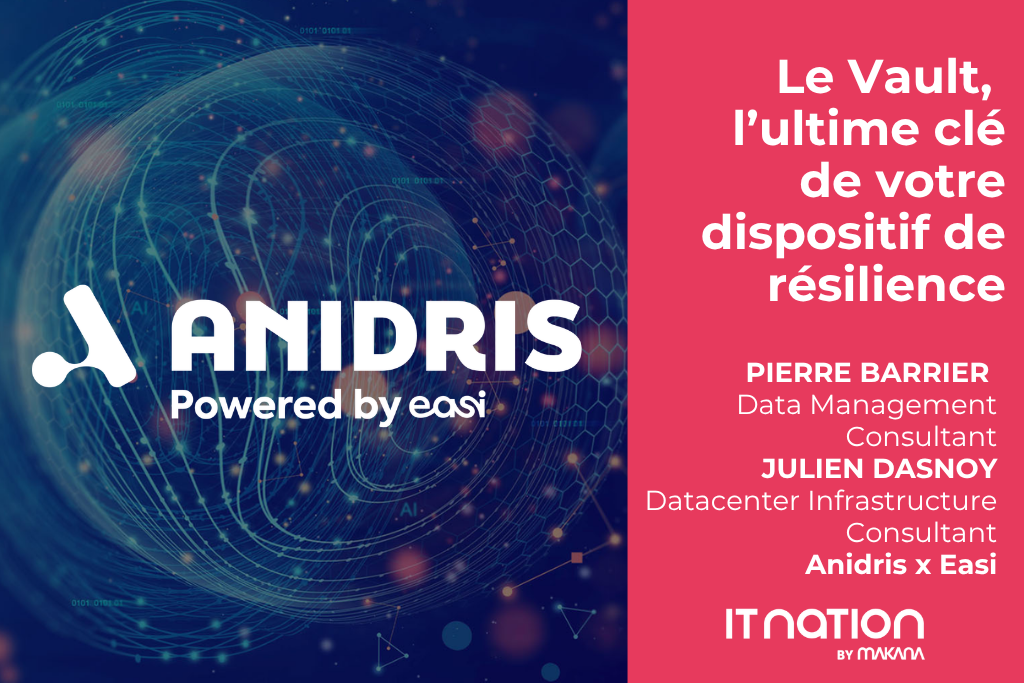
Isolating critical data to better protect it and accelerate recovery: the growing role of Vaults in cyber resilience.
Faced with cyber risks, companies must ensure they are able to rapidly restore the IT systems that are essential to maintaining business operations. With this objective in mind, an increasing number of organizations are implementing a Vault, an isolated environment designed to preserve data integrity, strengthen data protection, and facilitate system recovery. Anidris x Easi, a leading player in the management of critical infrastructures and data in Luxembourg, supports companies in the implementation of such a solution, notably relying on the Cohesity data management platform.
Within a company, the unavailability of information systems most often results in a complete halt of operations and can generate impacts across a broad ecosystem. In this context, the European Union has sought to prevent these risks by requiring organizations considered critical to strengthen their resilience. In the financial sector, DORA requires regulated entities to implement a number of measures. In other sectors, these challenges are addressed through the NIS2 Directive.
Strengthening recovery capabilities
“Today, performing regular backups is no longer sufficient to guarantee a company's resilience. Compromised backups can deprive the company of any possibility of recovery. Moreover, these copies are increasingly being targeted by attackers, whether the threat comes from outside or inside the organization,” explains Pierre Barrier, Data Management Consultant at Anidris x Easi.
How, then, can business recovery be guaranteed?
“Implementing a Vault addresses this challenge. The solution aims to keep a copy of the data in an environment isolated from the production environment, with strictly controlled exchanges and access,” continues the expert. “In addition, immutability mechanisms protect data against any attempt at modification or deletion for a defined period of time. Finally, the data is analyzed by antivirus and antimalware solutions in order to detect signs of compromise and enable recovery under the right conditions. Beyond the immutable and secure copy, the implementation of a Vault can also be associated with a dedicated recovery infrastructure, making it possible to restore and validate systems within a segregated environment.”
Preserving essential services
The Vault therefore constitutes a complete ecosystem in its own right. Its effectiveness relies on the combination of data protection, recovery infrastructure, and operational procedures. Its implementation, however, cannot be improvised.
“It must begin with the identification of the activities that are indispensable to the company's survival,” comments Julien Dasnoy, Datacenter Infrastructure Consultant at Anidris x Easi. “By carrying out a Business Impact Analysis (BIA), in close collaboration with the customer's business teams, we can define the Minimum Viable Company (MVC), meaning the essential services that must be restored to operate, potentially in a degraded mode.”
It is primarily the systems and data that ensure the continuity of these essential services that will be replicated within the Vault. The challenge at this stage lies in the requirement to take all application dependencies into account.
“A critical application may require a database, a directory service, or network services. All these components must be identified and integrated into the recovery scenario,” continues the expert. “Conversely, attempting to restore the entire information system indiscriminately may increase recovery times and raise the costs associated with the solution. That is why the scope must be defined precisely.”
An isolated architecture and segregated responsibilities
Only after this stage can the Vault be implemented. It is then necessary to establish a separate architecture, define access controls, and determine the methods for transferring and protecting copies.
To implement these mechanisms, Anidris x Easi relies on the Cohesity data management solution, which notably provides backup replication and immutability protection mechanisms.
“Beyond implementing this technological foundation, it is also necessary to prepare the recovery procedure in detail. Which components should be rebuilt first? Which accounts and configurations should be used? The answers to these questions must be documented in procedures developed together with system and application administrators,” explains Pierre Barrier.
To protect against the risk of internal sabotage, the Vault as well as the recovery procedures must also be managed by teams that are separate from those responsible for production systems. As part of the support it provides to customers, Anidris x Easi ensures the supervision and management of recovery-related activities.
Regularly testing recovery capabilities
Finally, it is also essential to test and verify these procedures, first on a single component, then on a set of services, and ultimately on the restoration of the entire essential scope. This preparation also reduces uncertainty for teams facing the stress of a crisis situation.
“The execution of backups is verified every day. Recovery capabilities must be tested regularly,” insists Julien Dasnoy. “Monitoring must confirm that the expected backups are reaching the Vault, that the copies correspond to the critical scope, and that access remains under control.”
And because a company's systems are constantly evolving, the teams responsible for managing the Vault must also ensure that the environment remains up to date by applying the required patches, implementing necessary technical changes, and supporting the lifecycle of the components.
“A new business application or an additional dependency can modify recovery conditions,” comments Pierre Barrier. “As a result, we remain in regular contact with our customers.”
End-to-end support
Anidris x Easi combines consulting, infrastructure expertise, data protection, implementation, and managed services. Its knowledge of customer environments makes it possible to connect business priorities with technical constraints and then support the solution over time, including the supervision and management of recovery operations.
“The real expected outcome is the ability to restore services,” summarizes Julien Dasnoy.
It is this capability, regularly tested and proven, that gives the Vault its full value.
- Cybersecurity