1963
My roots
I was born on August 27, 1963, the youngest of five children. My father left his bright Sicilian homeland in 1956 to work in the coal mines of Belgium’s Centre region. My mother joined him six months later. Neither of them spoke French. What courage! What an example for me.
Family is my foundation. It taught me strength, loyalty, and unconditional love.
1969
My education
School always felt easy to me. In secondary school, I chose Latin–Math almost by chance. Later, I enrolled in a degree in computer science — I was good at math and wanted a short program. My goal was simple: start working quickly and become a professional football player.
My parents never interfered with my choices. Not once. They didn’t check my report cards, but I knew they loved me deeply. I was free, autonomous, and responsible.
1983
RAAL & Sporting de Charleroi
At the age of 8, I discovered football at RAAL La Louvière. Very quickly, it became more than just a hobby — I played everywhere, all the time, driven by a burning passion. At 19, I joined the first team in Belgium’s Second Division, while completing the final year of my computer science degree. Two worlds that seemed incompatible, yet I managed to balance them thanks to strict organisation and sheer determination.
1982
Football and IT
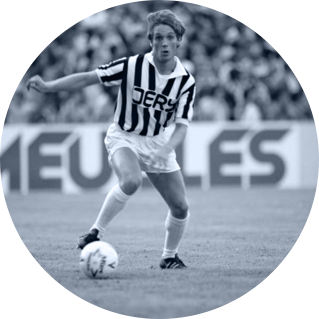
In 1982, I signed my first semi-professional football contract with Sporting Charleroi. At the same time, I landed my first job at SBAI, a company specialised in hospital software. I was 20 years old, juggling evening training sessions with a full-time job during the day. Over five years, I grew in both fields — progressing from programmer to project manager at SBAI, while playing nearly 70 matches in Belgium’s First Division with Sporting.
In 1985, we achieved a historic promotion to the First Division. It was an intense, demanding period, but incredibly formative. Football taught me discipline, perseverance, and teamwork. IT gave me structure, logic, and precision. These two worlds shaped who I am.
In 1988, the club offered me a full-time professional contract. It was a turning point. I was 25, and I made a bold decision: I declined. I chose to leave both professional football and IT to embark on a new adventure — the world of business.
1990
Commercial shift and manager career
At 25, I decided to change direction. I left professional football and IT to become a sales representative at IBS, an international IT company. I started working in Brussels, far from my usual environment, and started at the bottom of the pyramid again. It was a leap into the unknown, but I was driven by a desire to grow and step out of my comfort zone.
I continued playing football for a few more years in, Division 3 with RAAL, then in Division 2 with Stade Leuven, with a personal goal: to learn Dutch. At 28, I ended my professional football career for good and started coaching studies, out of passion.
That same year, in 1990, I married Patricia, the love of my life, whom I had known for five years. It marked the beginning of a new sense of stability. Meanwhile, my commercial career progressed quickly. At 30, I became Sales Manager. This role gave me broader responsibilities and allowed me to actively contribute to IBS’s growth, both in Brussels and Wallonia.
In 1993 and 1995, Céline and Stéphane were born and completed our family. These were intense years, filled with professional and personal challenges, but they reinforced my core beliefs: commitment, transmission, and the power of collective purpose are at the heart of everything I do.
1999
The creation of Easi
In 1999, I was 35 years old. IBS had just experienced an exceptional year: the team grew from 60 to 100 people and I was offered the position of General Manager for the Brussels office. On paper, everything looked perfect. But deep down, I wasn’t truly fulfilled. I longed for more freedom, more autonomy. After ten years of loyalty and relentless effort, I wanted to become a shareholder. But no solution was on the table.
So, I made a decision that surprised many people. I left my position, gave up a leadership role, and founded Easi with Christian Castelain. People called me crazy: crazy to borrow so much money, crazy to put my house up as collateral, crazy to start from scratch. I was confident, but I was also very much aware of the risk. My children were five and three years old, so that could have made me hesitate. But I moved forward, without looking back.
More than 25 years later, Easi has become one of Belgium’s top companies. We are now over 650 employees, with a turnover exceeding 100 million euros. But what matters most to me are the values that unite us: commitment, loyalty, and happiness at work.
Since 2015, we’ve been recognized as the company with the happiest employees at work in Belgium. Easi also uses a participative model financially: over 30% of our team members are shareholders. Our management committee is made up of people who started their careers with us. For me, that’s a tremendous source of pride.
A human-centered model
At Easi, people come first. But the company’s interests take precedence over individual ones. That clarity is what makes us perform so well.
Our pillars: Human Values, Organization, Effort, Sharing, Happiness.
Our values: Respect, Equality, Positivity, Professionalism, Loyalty.
Our ingredients for happiness: Recognition, Freedom, Transparency, Purpose, Love.
A true leader shapes leaders
By the end of 2016, Easi was thriving. The company was well-known, results were strong, and our internal culture was solid. Personally, I could have rested on my laurels and enjoyed what I had built. But a routine started to settle in, and with it, a sense of weariness. I felt the need to evolve my role.
I thought back to when I was 35, seeking more autonomy and not getting it. I didn’t want to repeat that pattern with my own team. I wanted to offer them what I didn’t get back then: the freedom to decide, to grow, to take their place.
That’s when I made a difficult but essential decision: I stepped down from the management committee. Not to retire, but to put a step aside. To make room for those I had mentored, for those who had grown with Easi. I firmly believe that a true leader doesn’t create followers, but new leaders. And that they must have the courage to be surpassed.
This choice freed me from power, but it also confronted me with a void. I didn’t yet know what I would do with this newfound time. But I knew I had just made a powerful move, true to my values: trust, transmission, humility.
It was a tough decision, but I’m proud that I made it.
2017
RAAL, a passion project
After stepping down from Easi’s management committee at the end of 2016, I found myself facing a new kind of freedom. A precious freedom, but also one that desorientated me. I needed a new project, a new meaningful challenge. That’s when the idea of reviving RAAL La Louvière football club became an obvious choice.
This club is part of my childhood. It’s where I discovered football at the age of 8 and where I was shaped both as a person and as a player. But beyond nostalgia, I saw a unique opportunity in la RAAL: the chance to bring the Easi model into a world that desperately needs it. Football is often plagued by individualism, money, and ego. I wanted to prove that another way is possible.
We launched a 10-year plan with a clear vision: to build a participative club, based on the same pillars as Easi: human values, organization, effort, sharing, and happiness. A club where staff, players, supporters, and partners move forward together in a spirit of transparency and collective responsibility.
I didn’t want to be a symbolic president. I wanted to get involved, get my hands dirty, and actively contribute at every stage. Starting from scratch, once again. This project is much more than a return to football. It’s an act of faith in the collective, in my hometown, in the belief that you can build something great while staying true to your values.
2019
Easi, Company of the Year
In 2019, Easi celebrated its 20th anniversary and won two major awards: 'Company of the Year' and the renewed title of 'Best Workplace in Belgium'.
But beyond the trophies, this moment was deeply symbolic. It marked the passing of the torch to Jean-François Herremans and Thomas Van Eeckhou, two team members who were trained internally and perfectly embody Easi’s DNA. This wasn’t a withdrawal, but a continuation. A way to prove that our model works: train leaders, trust them, and hand them the keys.
In 2021, I sold 20% of my shares to my colleagues, meaning I was no longer the majority shareholder. Easi is no longer my company, it’s our company now.
2025
RAAL in the Pro League and the Easi Arena
Eight years after its rebirth, RAAL La Louvière achieved the unthinkable: climbing the divisions, season after season, until reaching the Pro League. Two seasons were interrupted by covid, but we never lost sight of our goal. The promotion to Division 1 coincided with the inauguration of the Easi Arena: a brand-new stadium, designed by Carré 7, ICM-Wanty, and more than 180 local companies from Hainaut.
This stadium is more than just a sports venue. It’s a symbol. The result of a collective project, born from a city and carried by its driving forces. It embodies our vision: a participative, human, and ambitious football. A football that brings people together, that inspires, that respects.
Women’s Champions League Dream
And that’s not the end. Our women’s team also embodies this ambition. After an exemplary rise, they are now preparing to join the Super League (the top division of Belgian women’s football). But our dream goes even further: in four to five years, we want to welcome Europe’s top clubs to the Easi Arena for the Women’s Champions League. Juventus, FC Barcelona, and many more.
This project goes beyond sport. It carries a conviction that women’s football deserves the same energy, the same standards, and the same respect as men’s football. We’re writing a new chapter, with passion, with belief, and always guided by the same pillars: human values, organization, effort, sharing, and happiness.